(T.S. Eliot's first importance is as a poet, but he is also a major figure in criticism, and a significant, possibly under-rated, one in cultural and social commentary. I'm only going to consider the poetry here, and that excluding the plays, for the simple reason that I haven't read any of them except Murder in the Cathedral. If there is need later in the year, I might do an Eliot 2 on some of the prose works.)
I don't know whether “The Love Song of J. Alfred Prufrock” was the first poem that ever thrilled me, but it was certainly among the first. And my reading of it may have been the first occasion on which I was conscious of the experience as an experience specifically of poetry. At any rate I do remember my first reading of it. I was in my teens, I think not more than sixteen. And I think I had sought out “Prufrock”because I had read that it was very modern and advanced, which I wanted to be. I must have gotten a Selected Poems from the library, as I doubt that “Prufrock”would have appeared in a textbook (though in high school “The Hollow Men” did). I distinctly remember opening the book, and the pleasure of those opening lines; there was a physical pleasure, centered in the chest, and an emotional pleasure that was a sort of sad yearning, both arising from the music of the words and the images they invoked. And there was something that occurs more rarely: the exhilaration that comes from encountering a work of art that is not only very good but also seems to touch some deep part of one's own soul.
Sound and sense, then, but at a pretty basic level: there was no intellectual pleasure, really, apart from the process of comprehending the literal sense of the words. That is, I did not understand it in any sense beyond the fact that it was the voice of an unhappy man. I certainly didn't get the significance of Prufrock as a type, or his situation as a commentary on the state of his civilization. A few years later I learned about all that, and it was fascinating, and I grasped the place of the poem in the history of our culture. But on that first reading it was only the poem itself.
Now, fifty years later, it is once again only the poem itself that matters very much. The cultural history is interesting, to be sure, but it is history: the battles of early modernism are long since over. The modernist revolution has come—but not gone. It has permanently altered our culture, and become normal; it no longer agitates us. The alienation of modern man has been described and discussed so much that it is as much a part of our mental furniture as Duty was to a Victorian. As the shade of Dante says in “Little Gidding”: “These things have served their purpose: let them be.” But the poem is still very much alive. When I read it now, the sensation it produces is little different from what it was then.
Anyone who has even a slight interest in poetry has heard of “Prufrock” the poem, but I've just now looked over Prufrock the book (Prufrock and Other Observatiosn, 1917) for the first time in many years, and am struck by the fact that every poem in it is first-rate. There aren't many of them—Eliot was never prolific—but although they are not all equal they are all very fine. I had forgotten that the book includes “Preludes,” among my favorites of his shorter poems, which contains these lines, an image which has recurred to me now and then for decades:
I am moved by fancies that are curled
Around these images and cling:
The notion of some infinitely gentle
Infinitely suffering thing.
Only five years after Prufrock came the poem which is probably what most people would think of first when they hear Eliot's name, if they recognized it at all: The Waste Land. Yes, it is a landmark of literary modernism, and even if you came to it with no knowledge of its reputation it would be a very striking work. But I've never considered it a great work, except by virtue of its fame and influence. Or say perhaps that it is a great work, but a singular one, like Ulysses: an end rather than a beginning, and a constriction rather than an expansion. “These fragments I have shored against my ruins”—yes, I understand, but fragmentation has definite limits as a poetic technique, however fragmented the world appears to the poet, and Eliot himself saw that his technique in this poem was not a foundation upon which he could continue to build. The poem itself, and the poet, seem all but buried in those ruins; you have a sense of a partially collapsed structure, with walls rising out of rubble from which someone is trying to dig himself out. Still, there is a great deal of wonderful poetry in it:
“You gave me hyacinths first a year ago;
They called me the hyacinth girl.”
—Yet when we came back, late, from the hyacinth garden,
Your arms full, and your hair wet, I could not
Speak, and my eyes failed, I was neither
Living nor dead, and I knew nothing,
Looking into the heart of light, the silence.
Between Prufrock and The Waste Land there were a handful of shorter poems that I've never been very enthusiastic about, with the exception of “Gerontion.” “The Hollow Men” (1925) is a relatively straightforward poem which probably encouraged a lot of literary adolescents in the mistaken belief that it is easy to write free verse (I was one), and also gave us a famous (and now overused) verdict on the modern world:
This is the way the world ends
Not with a bang but a whimper.
Then came a movement toward both poetic and spiritual stability which bore fruit in “Ash Wednesday” (1930). “Ash Wednesday”gets less attention than it deserves—or perhaps I'm only describing my own habit. It's not a big and intense statement like The Waste Land, and although it's hardly traditional in form there's nothing startling about it, no juxtaposed fragments, no interjections of lines from Elizabethan drama, almost no French or Italian or German or Greek or Latin or Sanskrit.
Eliot had been received into the Church of England in 1927, turning his back on the watery liberal Unitarianism of his background. It was around this time that he described himself as “classicist in literature, royalist in politics, and anglo-catholic in religion” (according to Wikipedia, the lower case “anglo-catholic” is Eliot's). In the 1920s the Anglo-Catholic party within the Church of England was a significant presence, and it was no doubt less difficult to see oneself as truly Catholic within it then than now. In any case, “Ash Wednesday” is a very Catholic poem, a poem of Marian devotion in fact, full of addresses to Mary and quotations from the traditional prayers to her.
Blessed sister, holy mother, spirit of the fountain, spirit of the garden
Suffer us not to mock ourselves with falsehood
Teach us to care and not to care
Teach us to sit still
Even among these rocks,
Our peace in His will
And even among these rocks
Sister, mother
And spirit of the river, spirit of the sea,
Suffer me not to be separatedAnd let my cry come unto Thee
If you have somehow escaped reading Eliot, or perhaps remember only being bewildered by The Waste Land in school, “Ash Wednesday” might be a good place to start, especially if you're a Christian, though I suppose the Marian slant would put off some Protestants.
Or perhaps the “Choruses from The Rock” (1934). These are a set of rather prosey, openly didactic commentaries on the state of things in the de-Christianizing civilization of England. They were spoken by a chorus in a sort of pageant called The Rock, which I don't know much about. They are not Eliot's best work, and they are not a great work, but they are unmistakably in his voice, and what they have to say is still very much relevant, and often memorably said:
Do you think that the Faith has conquered the World
And that lions no longer need keepers?
Do you need to be told that whatever has been, can still be?
Do you need to be told that even such modest attainments
As you can boast in the way of polite society
Will hardly survive the Faith to which they owe their significance?
Men! polish your teeth on rising and retiring;
Women! polish your fingernails!
You polish the tooth of the dog and the talon of the cat.
Why should men love the Church? Why should they love her laws?
She tells them of Life and Death, and of all that they would forget.
She is tender where they would be hard, and hard where they like to be soft.
She tells them of Evil and Sin, and other unpleasant facts.
They constantly try to escape
From the darkness outside and within
By dreaming of system so perfect that no one will need to be good.
To a contemporary in 1935 it might have seemed that Eliot's career as a poet had run its course, and that he might be one of many who have produced brilliant work early in life, but then fallen into repetition, or faded away altogether. The Prufrock poems were written when he was in his twenties, The Waste Land in his thirties. His forties (1928-1938) produced fewer poems, and those less notable than his earlier work. If you had read “Choruses from The Rock” when it appeared, and been unsympathetic to their very direct and not very “modern” Christian statement, you would probably have thought that he was finished.
But in 1935 he published the first poem in the series that would become his greatest work, and in my opinion the greatest single poetic work in English of the 20th century: the Four Quartets. “Burnt Norton” first appeared in Collected Poems 1909-1935. The other three poems, “East Coker,” “The Dry Salvages,” and “Little Gidding” were written and published during the early years of the Second World War. I don't know enough literary history to know how many readers and critics recognized the greatness of the achievement in those first years—or, never mind greatness, how many simply liked them. But I do know that my opinion of them is not unusual, though it is probably not universal, either. Eliot said "I stand or fall on them." I believe the majority of critical opinion says that he stands.
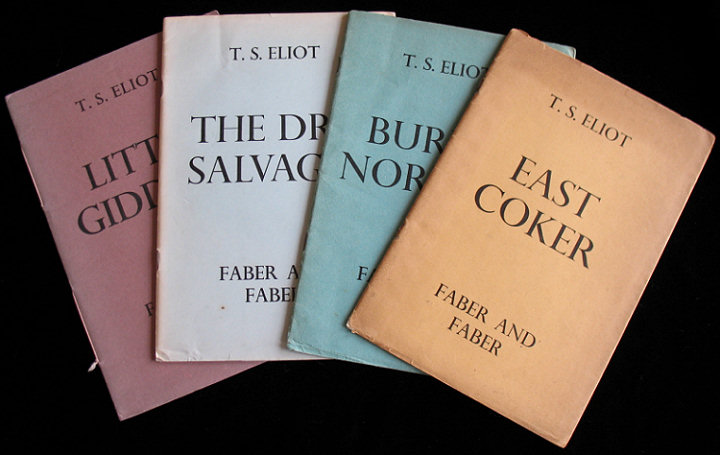
I first read the Quartets in the early 1970s. I had no real idea what they were about, nor did I fully recognize the Christian theology and philosophy in them. But I loved them almost immediately. I recall reading them in a time of intense personal distress and finding them comforting, although I didn't understand them. The sound and imagery in the descriptive passages, and the sense of serenity conveyed in the philosophical ones, gave me a sense of peace which didn't depend on a full grasp of meaning.
Forty or so years later, having read the poem, I suppose, at least a dozen times, and having come to cherish it, what I just said is still applicable. I'm still more than a little puzzled by some passages, and could certainly not produce an answer to the question “What is Four Quartets about?” that would be both brief and useful. The Waste Land is of course known as a difficult poem. But Four Quartets may be more so. The former is difficult in great part because of its technique—its fragmentation, its dependence on allusions which the reader may not get (thus the famous or infamous notes, which I have read may have been intended as a joke). The latter is difficult because it deals in complex ideas. There is some difficulty of the modernist poetic sort, beginning with the question “what are the voices or instruments comprising the quartets?”; the answer is not at all obvious. But the greater difficulty is intrinsic: the “complex ideas” of which I just spoke are probably not even best described as ideas. I'll call them instead, simply thoughts, mindful that the word is one frequently used in a banal way. Perhaps it would sound more dignified if I said “thought”, singular. A newspaper columnist offers us his thoughts, a philosopher his thought.
At any rate what I mean is that what is being expressed is not an idea or set of ideas that can be stated in a straightforward manner, but the full product of consciousness, which includes propositional sense, intuition, emotion, and sensual apprehension. This is always true of poetry, of course, but in the Quartets the object of consciousness—not necessarily the object obtained, but the object sought—is metaphysical. And so the poet as well as the reader finds himself in difficulties. There are two or three passages in which he complains:
So here I am, in the middle way, having had twenty years—
Twenty years largely wasted, the years of l'entre deux guerres—
Trying to learn to use words, and every attempt
Is a wholly new start, and a different kind of failure
Because one has only learnt to get the better of words
For the thing one no longer has to say, or the way in which
One is no longer disposed to say it. And so each venture
Is a new beginning, a raid on the inarticulate
With shabby equipment always deteriorating
In the general mess of imprecision of feeling,
Undisciplined squads of emotion.
I see I'm over two thousand words here, which is enough to ask of people reading online. And anyway it would be foolish of me to attempt much commentary on the poem without a good deal of study and thought. So I'll end this with one remark, and another quotation. The remark: Four Quartets is an extended and profound meditation on time, eternity, consciousness, history, culture, faith, and the Incarnation, and it is more important to me than any work of theology. The quotation, which begins where the preceding one leaves off:
And what there is to conquer
By strength and submission, has already been discovered
Once or twice, or several times, by men whom one cannot hope
To emulate—but there is no competition—
There is only the fight to recover what has been lost
And found and lost again and again: and now, under conditions
That seem unpropitious. But perhaps there is neither gain nor loss.
For us, there is only the trying. The rest is not our business.—”East Coker,” V
By the way, I did not forget Old Possum's Book of Practical Cats. It is a perfect work and needs no commentary.
—Yr hmbl srvnt, the proprietor of this blog.
 Light On Dark Water
Leave a comment