I have dithered over how best to approach this little introduction to The Tree of Life. My burden is that I've volunteered to write about the film that means more to me than any other. It's a work of art that touches me as Josquin's Ave Maria or van der Weyden's Deposition do: right there in my soft center. How can I do it justice? Shall I take my inspiration from the film itself, embark on a flight of rhapsody, and bear my reader aloft like a feather on the wind? Shall I whisper quietly in his ear the secrets of my heart? Introduce an interlude on natural history? Shall I fragments allow to splinter to my prose? Shall I try to carry it off without using words at all?
The Tree of Life is a rich film, ravishing in its beauty, and resonating internally with profound ideas, but it is also a very tangible film, grounded in a particular time and place. There are sequences in which I feel I could almost reach out and touch it, breathe it in, or which set me back on my heels with a shock of recognition: I remember that. Indeed, the whole film can be (and has been) interpreted as a sustained descent into memory, a reverie in which experience is pondered, turned this way and that, sifted, shot through with longing. Like St Augustine's Confessions, it is a work in which mystery and memory intertwine, in which the inscrutable majesty of the Divine and the inscrutable mystery of one man's life meet.
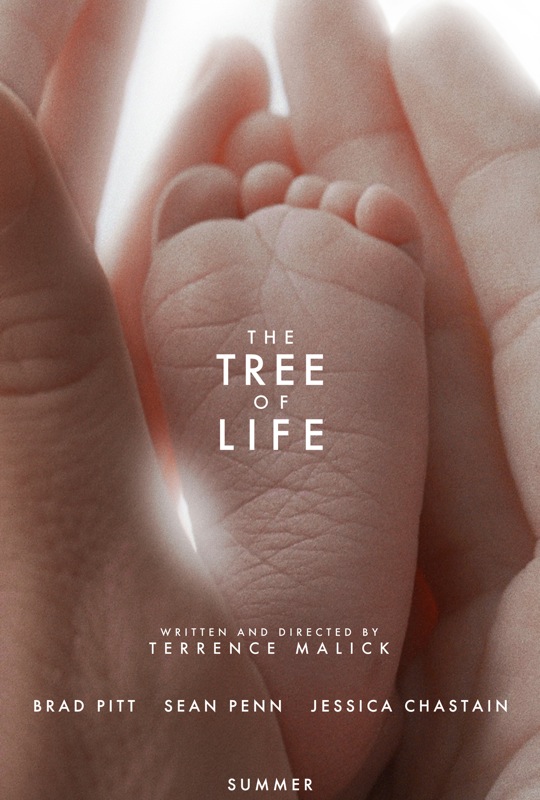
But I am getting ahead of myself. The Tree of Life is the work of Terrence Malick, a filmmaker almost as famous for not making films as for making them. His first two films, Badlands in 1973 and Days of Heaven in 1978, had earned him critical plaudits and a place at the table with the new generation of American filmmakers then coming to prominence. But following Days of Heaven he went quiet for twenty years (though not so quiet as is sometimes thought, for during that long period he worked on a number of scripts and projects that never came to fruition, including an adaptation of Percy's The Moviegoer). When he re-emerged in the late 1990s with The Thin Red Line he might as well have been a different filmmaker. True, there were some similarities between the earlier period and the later, but the differences were more than a matter of degree. He had found a way to invest the very grammar of film — sound, editing, and camera movement — with his own personal vision, a style distinctly his own. Malick has been compared to Tarkovsky, or to Kubrick at his most ambitious, but really there's nobody like him.
The very title of this film is an evocative one. We think of the scriptural Tree of Life which stood in the midst of the garden, and again of the Tree of Life which appears on the last page of the Revelation to St John, the leaves of which are for the healing of the nations. I myself think of Christ's words: "I am the vine, and you are the branches… Abide in me, as I abide in you." But the Tree of Life also appears in On the Origin of Species, where it covers the earth with its ever-branching and beautiful ramifications, and so we might justly call to mind the tumbling and twisting genealogical tree of life on earth, being reminded of that deep history, of that litany of forms, of strange beauties and violent deaths, and of the fact that sons are descended from mothers and fathers.
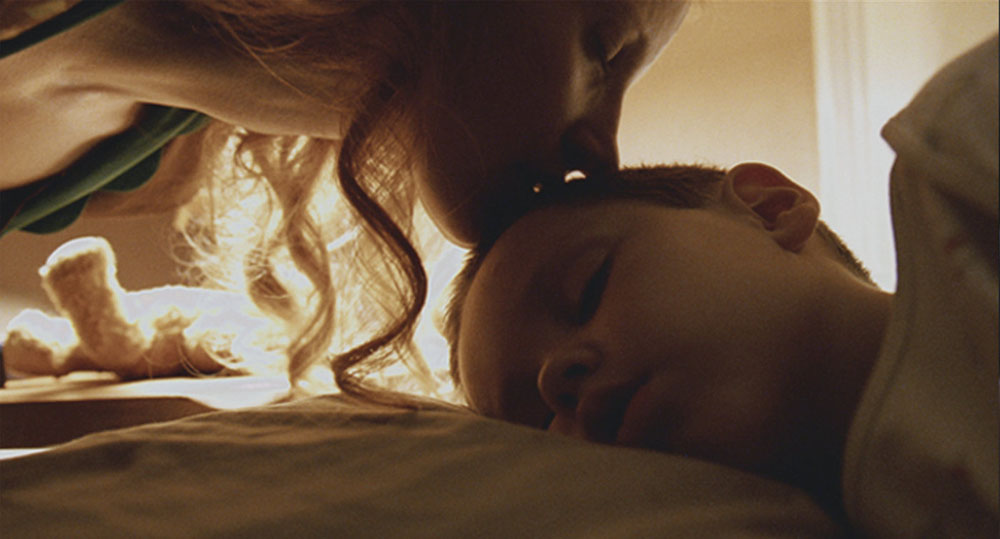
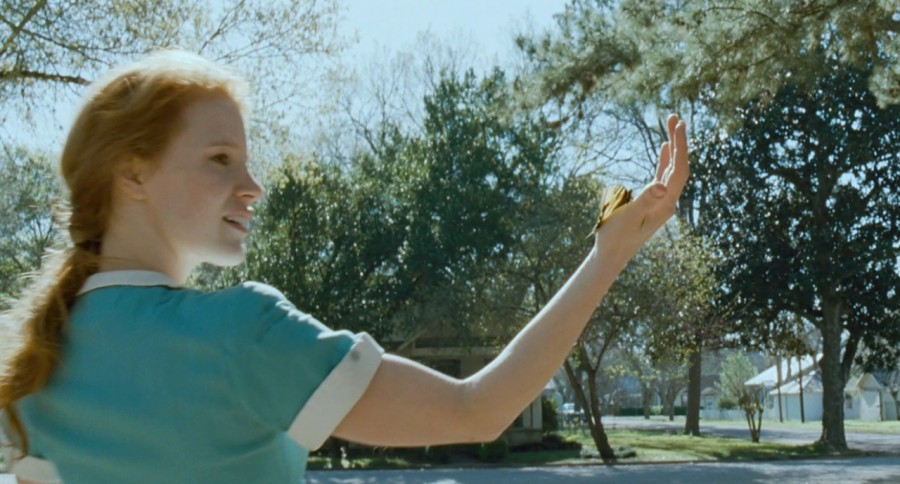
The O'Briens have three sons. They live in a quiet neighbourhood of a small town in Texas in the 1950s. It is a time and place where boys roam until dusk, chasing one another, wandering through fields and forests, breaking windows in abandoned buildings. The yards have no fences. Mr O'Brien (Brad Pitt) is a responsible and hard-working man, but is not rewarded as he thinks he should be, and he lives, it seems, with some regrets over the path he has chosen in life. He teaches his sons that life is a struggle, and that they must be strong. He loves his boys, but he is hard on them, and perhaps he does not know how to be otherwise. Mrs O'Brien (Jessica Chastain) is the heart of the family, and she takes her boys gently under her wing; she teaches them that they must love.
For most of the film we are in and around the O'Brien's home, floating down its hallways and drifting from room to room as though gently nudged by a gust from an open window. (One of the joys of The Tree of Life is that the camera, wielded by Emmanuel Lubezki, almost never stops moving.) We watch the children as they grow, ponder the sometimes tender and sometimes troubled relationship of the parents, and see the common joys and perils of family life unfold before us, vividly realized, and in the shade of the great tree that lifts its lofty, spreading branches over the home.
Suffering visits the O'Briens, as it visits us all. "There is no hiding place in all the world where trouble may not find you," says their priest from his pulpit. The boys witness disease and deformity. We are not five minutes into the film before death visits them. And the darkness does not just encroach from without, but emerges from within: Jack (Hunter McCracken), the boy whose story the film is, must contend against the lust and anger of his own heart, forces that he himself hardly understands.
The Tree of Life can be seen as a great wrestling with evil: where does it come from? why does God permit it? what does it mean? The book of Job is the film's Biblical touchstone: we meet Job's friends, we ask Job's questions, and, in one of the film's most thrilling and audacious sequences, we witness God's reply to Job: Where were you when I laid the foundations? This reply of God's has been the occasion for much baffled commentary. We're unaccustomed to a filmmaker who departs from his story to show us how the world came to be. Except of course it is not really a departure, but character development. The O'Briens are not the only characters with leading roles in The Tree of Life.
If we think of this film as a symphony — and this is a remarkably fruitful way to think of it — we are right to identify suffering as a recurring motif. But the principal themes are wonder and love. The spirit of Mrs O'Brien — or, rather, the spirit of which she is a lowly handmaid — pervades the film, setting the screen aglow. The sheer beauty of the world, the wonder of being, the shining glory of what is, unaccountably, not nothing — these are the film's deep sources, and they seep into our hearts as the images wash over us until, at its best, and for those attuned to its vision, the film becomes an occasion for prayer.
So, at least, has been my experience. Not everyone, I know, has responded to it in this way. Sometimes seed falls on rocky ground, or among thorns. Bewilderment and exasperation were not uncommon responses when it played in theatres. Some couldn't keep straight who was who. Some didn't like the dinosaurs, or the splashes of surrealism. Some found the narrative thread too thin and allusive. Some found it pretentious, or were confused by its theological vision. Well, we shouldn't expect the greatest films to satisfy conventional expectations. And, as even I will admit, the film does have its weak points. (The last quarter-hour, a much-discussed excursion into Jack's soul, or into the afterlife, or into some abstract psychic space, is suggestive and subtle and grows more so with each viewing, but is still, I think, a failure.)
But, my friends, few films come our way with this much feeling, with this ecstatic power, with this determination to pursue that which is always only seen from the corner of the eye, and with such an abundance of beauty as to make the heart tremble. Love every frame.
—Craig Burrell is a longtime reader of Light on Dark Water, and blogs at All Manner of Thing.
 Light On Dark Water
Leave a comment