Katrine Myrdal’s (Juliane Köhler) life is about as close to perfect as lives get. She lives in Norway in a lovely house on a cliff overlooking a fiord in a beautiful sylvan setting with her loving husband, her daughter, granddaughter and her dear mother (Liv Ullmann). She is happy in her home and successful in her career. Why, then, do we meet her in disguise, a tense and haunted woman on a mysterious trip to Berlin?
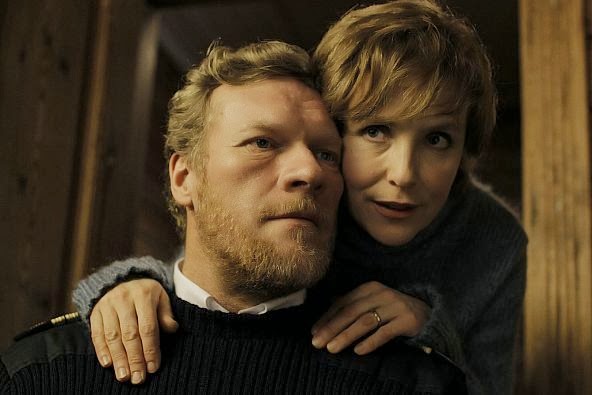
Two Lives (Zwei Leben) is in some ways similar to Michael Clayton. The main character is suspended between two versions of herself that cannot continue to exist in tandem. There is a loving family on one side, and a system of intrigue and death on the other. However, while Clayton has a choice to make, the choices that Katrine made in the past are rapidly bringing any chance she has to control her life in the future to an end.
Two Lives takes place in 1990, shortly after the fall of the Berlin Wall and the reunification of Germany. The catalyst that sends Katrine on her clandestine trip to Berlin is a visit from a young and zealous lawyer, Sven Solbach, who is bringing a suit to seek reparations for Lebensborn Norwegian children. These were children of German soldiers and women who lived in occupied Norway during World War II. They were taken from their mothers and sent to orphanages in Germany, and then perhaps to live with German families, the point being to raise children to serve the Reich. Solbach believes that the testimony of Katrine and her mother, Ase, is crucial to the case because Katrine was the only kidnapped child who as a young woman escaped and returned to her mother. This, by the way, is not true. In reality there were other escapees, but I suppose this unhistorical construct was important to the movie.
In Berlin, Katrine visits the former orphanage seeking information about one of the nurses and making sure that any mention of this nurse and of Katrine Evensen is removed from any public records and destroyed. She calls a man named Hugo and tells him that she is in danger, and gradually we begin to learn about her past life.

The story is told in the form of flashbacks—in bits and pieces—and takes a long time, the rest of the movie really, before we figure out what really happened. The flashbacks are grainy, which gives them a sense of having been filmed long ago, and which is probably helpful in hiding the age of the actors who are playing their younger selves. The only characters who are played by different actors in the past and present are Katrine and her husband. The actress who plays the young Katrine, Klara Manzel, is so like Juliane Köhler in both looks and mannerisms that it took me a while before I was sure that it really was two different people.
The acting throughout is good. While Juliane Köhler, whose character, like Karen Crowder, is desperately trying to hold her life together, is not as proficient as Tilda Swinton, she does a good job of portraying a woman who stands to lose everything she holds dear, and Katrine, unlike Karen Crowder, has very much to hold dear. Liv Ullmann is, of course, excellent. She does not spend a lot of time on screen but when she appears, she excels in her own quiet way. The final shot of Ms. Ullmann looking out the window captures all the sadness and bewilderment of the family's plight.
I had not previously known anything about the abduction of these children by the Nazis or the way in which they used some of the children like Katrine. It's a very distressing story, and while Katrine made some bad choices in her early life, when we find what was behind the choices, it is heartbreaking.
The movie is loosely based on Ice Ages, a novel by Hannelore Hippe which had not been published previous to the film. Wikipedia says:
She was inspired by reports in the late 1980s of the discovery of the half-burned body of a young woman near Bergen, and there was speculation as to her identity. This was just before the fall of the Berlin Wall and reunification of Germany.
I tried to find out more about Hannelore Hippe, but could find little except that her real name is Hannah O'Brien, and that she is a novelist and journalist who has written several books, one about Einstein and one about the Summer of Love—yes that Summer of Love. I'd like to read Ice Ages but it doesn't seem to be available anywhere.
I suppose that you would say that Two Lives is a thriller. Some reviews say that is in the manner of something by John le Carre. I don't know because I'm not that familiar with his work. When I watch a film, I don't usually think in terms of genre. What really interests me about films is the characters, and the story, and whether or not one can find grace lurking in some unexpected corner. In this case, I found the characters and the story to be engaging, but I'm sorry to say that grace seemed to be completely lacking, which is part of the tragedy of the film. One wonders how the story could have been different with the slightest bit of illumination in the life of even one of the characters. I'm not saying that I think that the movie should have been different, only that it illustrates the weaknesses inherent in a simply secular view of life.
I would suggest that if you are interested in watching the movie, you not read any reviews beforehand. They all seem to give too much away.
—Janet Cupo has been commenting on this blog for about as long as it's existed, and has her own excellent blog at The Three Prayers.
 Light On Dark Water
Leave a comment