Note: I learned (see the comments) after posting this that the book, unfortunately, is currently out of print.
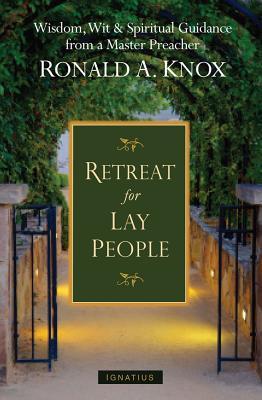
I have only read about half of this book, and that was over a period of months. I take it with me to my weekly hour of Eucharistic vigil, much of which generally passes with my thoughts wandering all over the place, some of which passes in reading. More often than not I don't even open this book, which is why I'm only on chapter XII of XXIV.
But I'm writing about it now because it's only a week until the start of Lent, and I think this would be good Lenten reading. It's a series of talks given at retreats by Fr. Knox in the '40s and '50s (I think). It's down-to-earth and fairly casual, even light, in tone–at one point he mentions the sort of annoying acquaintance that we would like to "squash"–but rich with insight.
It was the last chapter I read that made me think to recommend it now. The chapter is called "Six Steps to the Crucifix," a title which made me expect a Stations-of-the-Cross sort of discussion, but it isn't that. The steps referred to are approaches to understanding and contemplating the Passion, beginning with a view of it as a fairly straightforward and all too common instance of human crime and folly.
On the lowest level of all, then, what does the spectator of Calvary say to himself? He shrugs his shoulders and comments, "Well, I suppose that is the way of the world! Here was a man who was too good for his generation; and his generation took the short way, and made an end of him." I doubt if there is a single human being who will not go as far as that, who will not pay that much tribute to the character of Jesus Christ. However low you rank him in the scale of human achievement, you will put him in the same class with Socrates. Socrates went about the world trying to make people think, trying to make people see that there must be a right and a wrong way of living…. And the good people of Athens called him an atheist and made him drink poison. Five centuries later, Jesus of Nazareth came, and he taught, well, perhaps not exactly the same but the same kind of thing….being merciful to your neighbor, judging him charitably, trusting Providence, being sorry when you had done wrong. And the Jews crucified him. It is the way of the world.
Of the world; we mustn't go away saying "Of course, Jews are like that." No, Jews and Gentiles are like that, the world is like that, and you and I are the world.
And from there he goes on to look at the Crucifixion from increasingly un-natural and more mysterious points of view, ending with the acknowledgement that it is something beyond human comprehension.
I plan to read the remaining XIII chapters during Lent.
 Light On Dark Water
Leave a comment